
ORAgentBench code is available at ORAgentBench/ORAgentBench.
Execution-grounded operations research agent benchmark
Can LLM agents solve operations research tasks end to end?
ORAgentBench evaluates autonomous agents inside realistic OR workflows: reading operational artifacts, building mathematical models, running solver code, and submitting auditable decisions checked by hidden validators.
107
human-reviewed executable tasks
14
complete model-agent rows
35.51%
best all-task pass rate
20.59%
best hard-task pass rate
Latest News
Project updates
ORAgentBench paper is available on arXiv at arXiv:2606.19787.
Main leaderboard published with 14 complete model-agent rows over 107 executable OR tasks.
Overview
Real OR work, not only formulation text
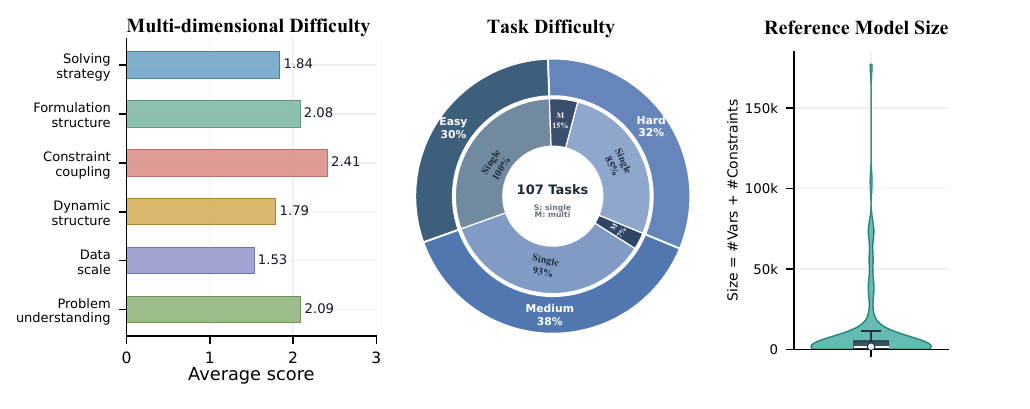
Each task packages a natural-language operational brief, multi-file data, configuration artifacts, and a required submission schema inside an isolated Harbor environment. Agents must produce executable solver code and decision artifacts that pass schema, feasibility, and normalized quality checks.
Evaluation Protocol
Feasibility is necessary; quality is decisive
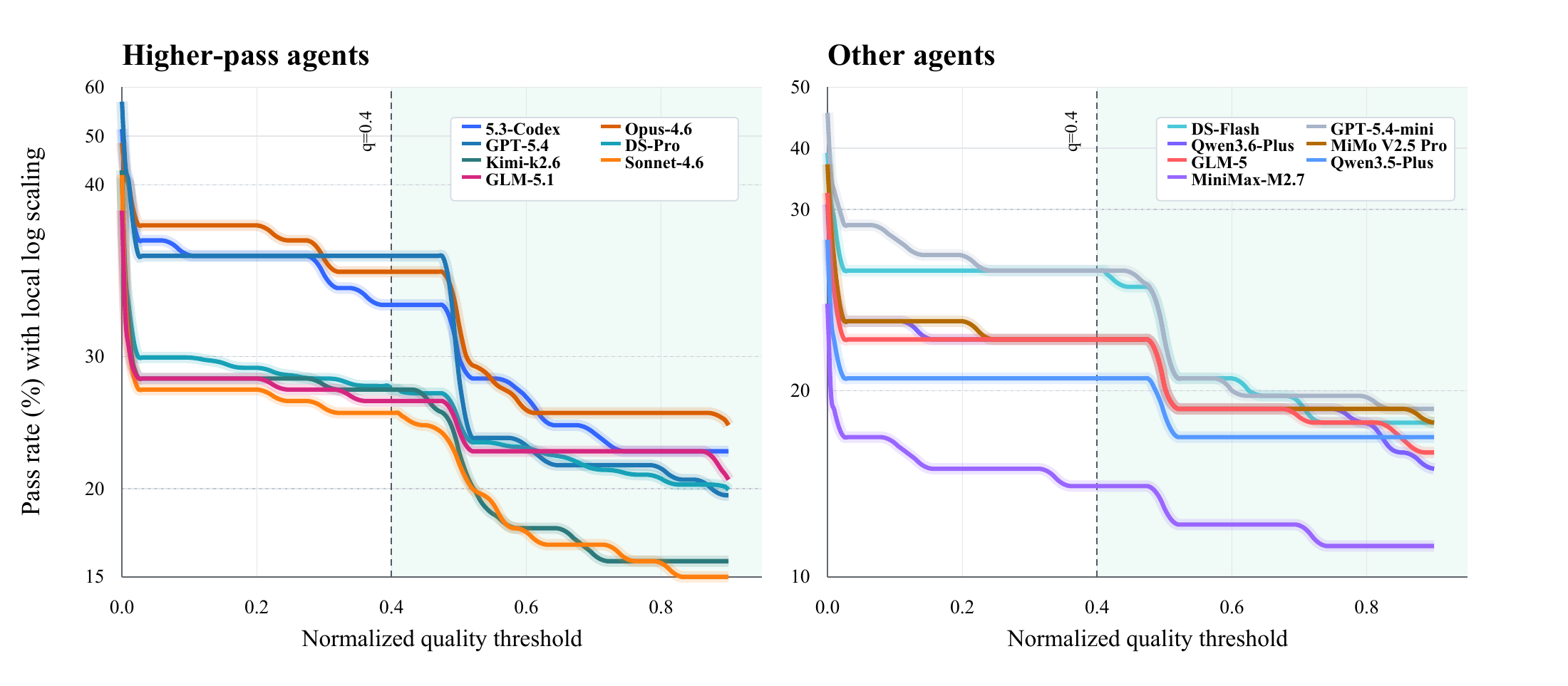
A task is passed only when the submitted artifact is feasible and its normalized objective quality clears the benchmark threshold. This separates runnable code from useful operations research decisions.
01
Schema validity and required artifact checks
02
Hard operational constraints and domain rules
03
Normalized objective quality against task reference metrics
Benchmark Construction
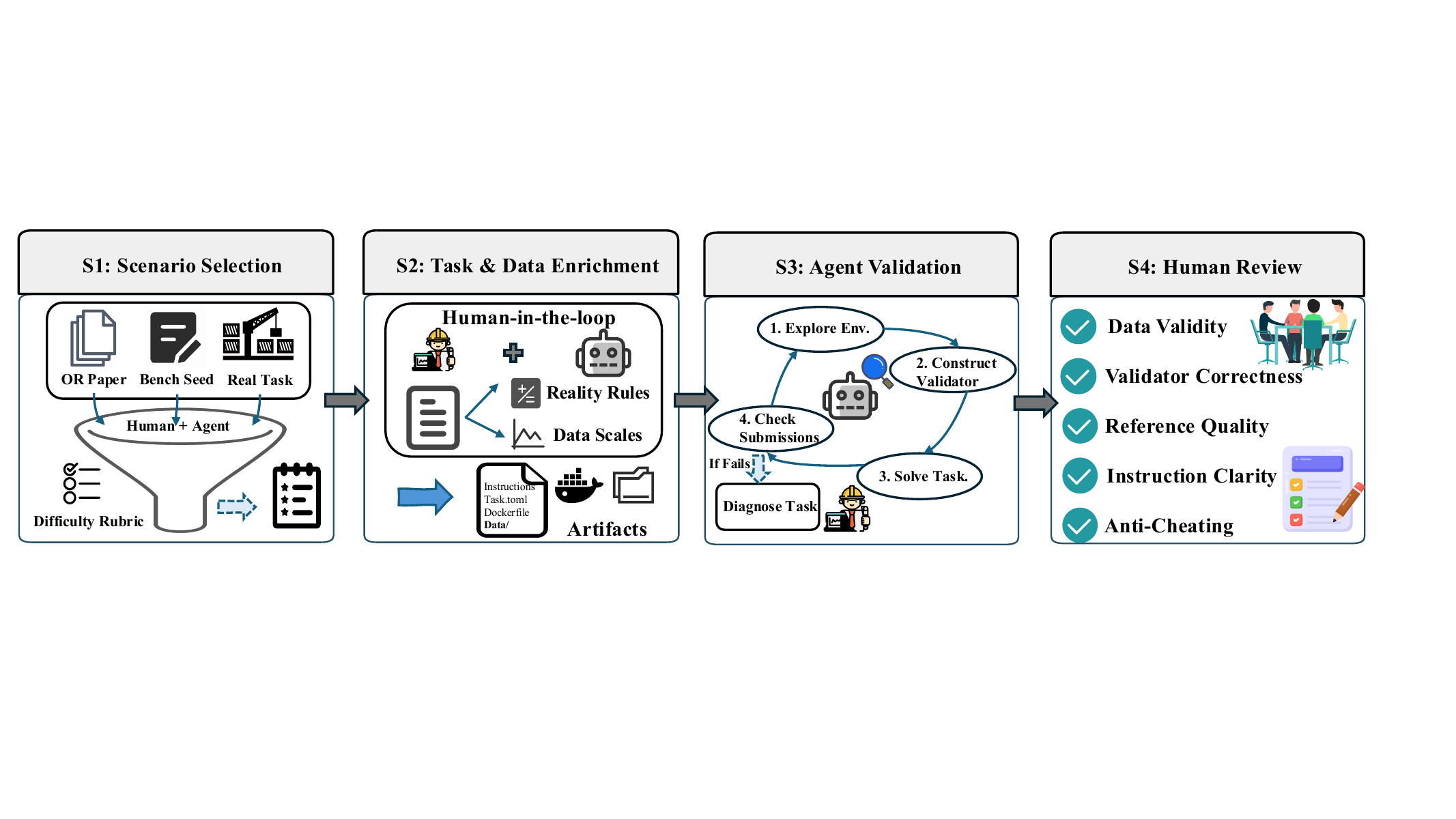
Executable tasks with hidden validators
ORAgentBench focuses on the full agent loop: inspect files, infer the optimization model, implement a solver workflow, run experiments, and submit decisions. Hidden validators check whether outputs are well-formed, feasible, and competitive against task-specific reference metrics.
Results Snapshot
Current top systems
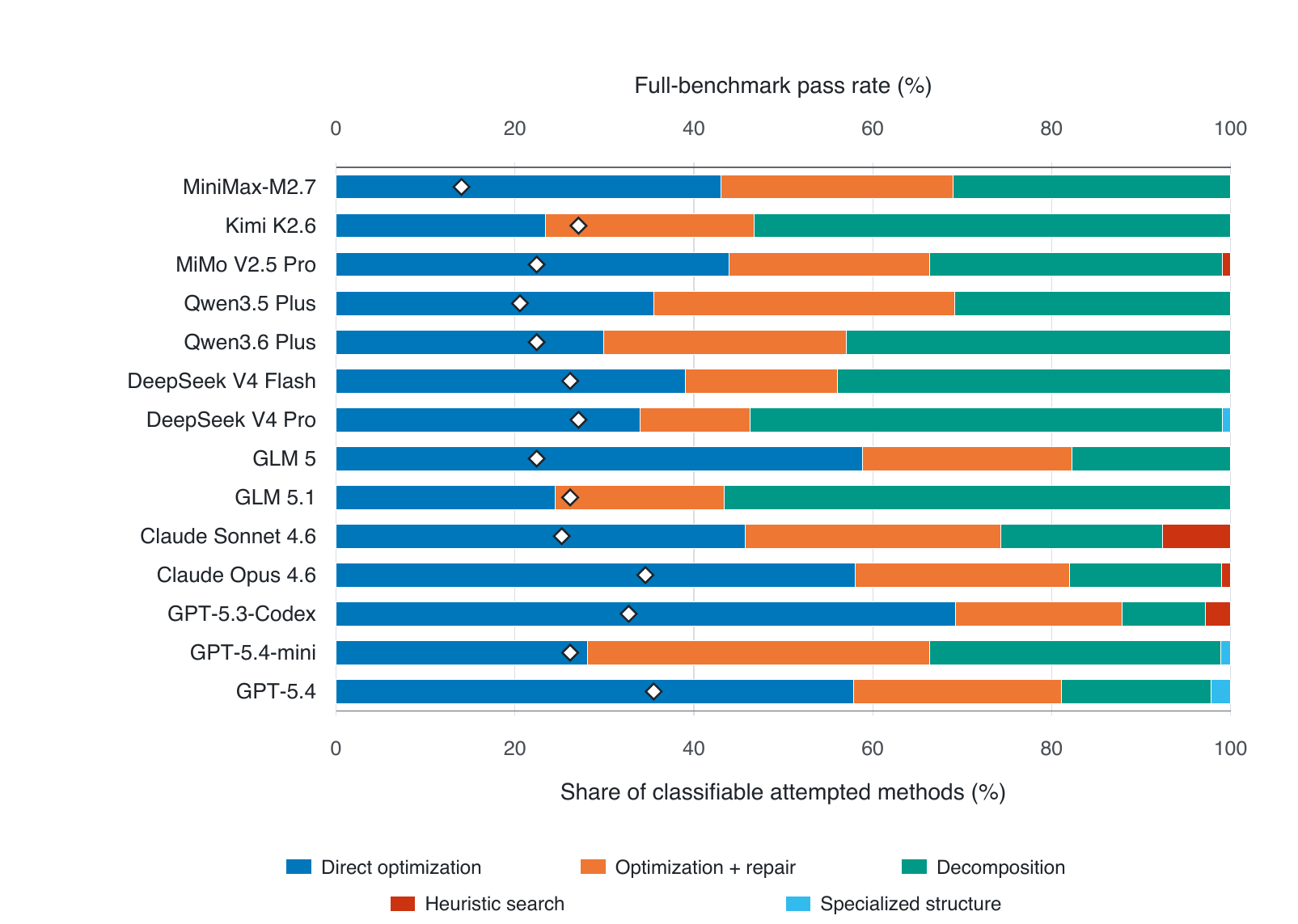
The public leaderboard reports pass rate, feasibility, and normalized quality across easy, medium, and hard splits.
Loading leaderboard...
@misc{li2026oragentbench,
  title        = {ORAgentBench: Can LLM Agents Solve Challenging Operations Research Tasks End to End?},
  author       = {Jiajun Li and Mingshu Cai and Yixuan Li and Yu Ding and Ran Hou and Guanyu Nie and Xiongwei Han and Wanyuan Wang},
  year         = {2026},
  eprint       = {2606.19787},
  archivePrefix = {arXiv},
  primaryClass = {cs.AI},
  doi          = {10.48550/arXiv.2606.19787}
}